
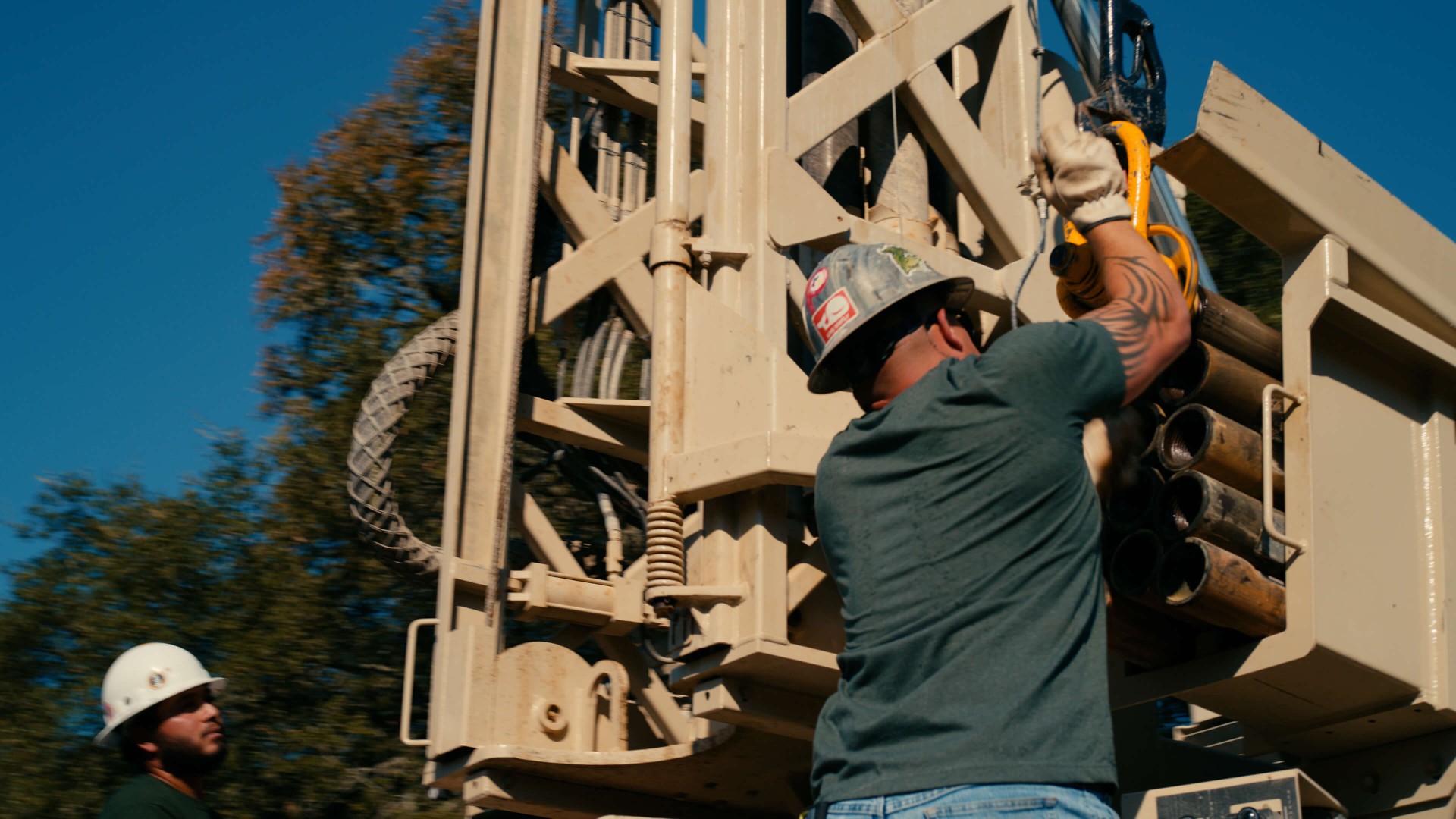
Water Well Drilling Rigs & Equipment



Republic Drill Co. supplies water well drilling rigs and the equipment that keeps them producing: residential and agricultural wells, municipal and public-supply wells, irrigation and livestock wells, and monitoring or dewatering holes drilled in everything from unconsolidated sand and gravel to hard granite.
The lineup covers mud rotary, air rotary and down-the-hole hammer rigs in truck, track and trailer configurations, along with the support equipment that goes with them — mud pumps and mixing systems, air compressors and boosters, pipe handling, and grout and casing equipment. We work with manufacturers whose rigs are built for North American well programs, including Comacchio hydraulic rigs and Perforator drilling tools, and we source and broker used iron when a program needs a rig sooner than a build slot allows.
Behind every rig is the part of the business most contractors judge us on: drill pipe and subs cut to your thread, DTH hammers and bits stocked by size and formation, wear parts and filtration on the shelf, and technicians who commission rigs and rebuild rotary heads. The outcome is a well program that stays on schedule — fewer days waiting on a part, fewer holes lost to the wrong tooling, and a rig that is still making footage in year ten.
Water Well equipment we supply
Inventory, availability and rig configurations change constantly, and many machines are quoted to spec rather than held in stock. These are the equipment categories we supply for this segment — tell us the program and we'll quote the specific configuration.
Mud rotary rigs
Truck and trailer rigs for residential, agricultural and municipal wells in unconsolidated formations.
Air rotary & DTH rigs
High-pressure air rigs for hard-rock production wells, with rig-mounted or towed compressors.
Dual rotary / cased advance rigs
Casing-advance rigs for caving ground, artesian conditions and aquifer protection.
Compressors & boosters
Air packages sized to hammer, hole diameter and depth.
Mud systems & pumps
Mud pumps, tanks, mixers and solids control for fluid programs.
Pump hoists & support trucks
Service rigs for pump setting, well rehabilitation and maintenance calls.
Water Well drilling methods and the equipment they take
Mud rotary
Circulating drilling fluid to carry cuttings and stabilize the borehole. The default method in sand, gravel, clay and soft sedimentary formations, and the method most residential and irrigation wells are drilled with.
Mud pump, tricone or drag bits, drill collars, mud tanks and mixing
Air rotary
Compressed air lifts cuttings instead of fluid. Faster penetration in competent rock, no mud pit to manage, and immediate feedback on water production as you drill.
Rig-mounted or trailer compressor, booster, tricone or DTH bits
Down-the-hole (DTH) hammer
A percussion hammer at the bit face driven by high-pressure air. The most common method for deep hard-rock wells and the fastest way through granite, basalt and dense limestone.
4" to 8" hammers, bit faces matched to formation, boosters
Dual rotary / cased advance
Casing is advanced with the hole in caving or artesian ground, keeping unstable formation out of the borehole and protecting the aquifer.
Casing drive, casing shoes, sacrificial shoes and welded casing
Cable tool & auger
Still in service for shallow wells, test holes and formations where a slower, simpler method is more economical than mobilizing a rotary rig.
Hollow-stem and solid-flight augers, bailers, drive shoes
How to choose the right water well rig
- 01
Start with the formation, not the rig
Overburden depth, rock hardness and whether you expect caving ground determine method before anything else. A hard-rock program is a DTH conversation; alluvial aquifers are a mud rotary conversation.
- 02
Set a real depth and diameter range
Spec the rig for the deepest, largest-diameter well you actually sell — not the one you drilled once. Hoist capacity, pullback and mast height all follow from that number.
- 03
Match the air package to the hole
Hammer performance is a function of cfm and psi at the bit, corrected for depth and annulus. Undersized air is the most common reason a DTH rig underperforms its brochure.
- 04
Pick the carrier for your access
Truck carriers move fast between road-accessible sites. Track carriers earn their keep on soft, wooded or sloped lots. Trailer rigs suit tight residential access and a smaller crew.
- 05
Plan the support fleet
Water truck, support truck, pipe trailer and pump hoist are part of the cost of the program. Buying a rig without them delays the first well.
- 06
Confirm parts and service coverage
Ask what is stocked domestically, what lead time looks like on a rotary head, and who is coming out when the rig is down. That answer is worth more than a spec sheet line.
Specifications buyers compare — and why they matter
| Specification | Why it matters |
|---|---|
| Rated drilling depth by diameter | Depth ratings are quoted at a given hole size and drill pipe weight. Compare at the diameter you actually drill. |
| Hoist / pullback capacity | Governs how much string, casing and tooling you can pull out of a deep or stuck hole. |
| Rotary head torque and speed range | High torque for casing advance and large tricones; high rpm for smaller-diameter and core work. |
| Pulldown force | Weight-on-bit for tricone drilling; too much pulldown on a DTH hammer costs bit life. |
| Air package (cfm / psi) | The single biggest driver of DTH penetration rate and hole cleaning at depth. |
| Mud pump output (gpm / psi) | Determines annular velocity — whether cuttings actually leave the hole. |
| Mast height and single/double length | Sets rod handling cycles per 100 ft and how tight a site you can rig up on. |
| Carrier, GVW and axle configuration | Road legality, permit requirements and where the rig can physically get to. |
| Hydraulic system and engine tier | Drives fuel burn, emissions compliance and how the rig behaves at altitude and in heat. |
Who we represent in water well drilling
The support behind the rig
Drill pipe & rod
Perforator DTH, rotary and RC drill pipe, subs and crossovers matched to your rotary head thread, torque rating and hole depth.
Drill pipe →Bits, hammers & tooling
DTH hammers and bits, tricone and drag bits, rock drill steel, shanks, and couplings stocked by size and formation.
Tooling →Parts & consumables
Wear parts, filtration, hydraulics, rock drill oil, and thread compound. Stocked items ordered by 3PM CST ship next day.
Consumables →Field service & shop repair
Rig commissioning, preventive maintenance, hydraulic and rotary head rebuilds, and troubleshooting — in the shop or on location by territory.
Field service →Hard-rock residential program, Central Texas
A contractor running air rotary in limestone and granite was losing days to bit changes and slow returns below 400 ft. Reviewing the program with our tooling group showed the air package was undersized for the annulus at depth and the bit face was wrong for the formation transition.
Re-specifying hammer size and bit face, adding a booster, and stocking a standing bit order at the shop returned the crew to single-day completions on typical wells and cut unplanned trips out of the hole.
Water Well equipment questions we get asked
What size water well rig do I need?
Spec from the deepest, largest-diameter well you sell regularly. Confirm the rig's rated depth at that hole size, then check hoist capacity against the weight of the string plus casing you'd have to pull if the hole gets tight.
Mud rotary or air rotary for water wells?
Mud rotary suits unconsolidated sand, gravel and clay where the borehole needs fluid support. Air rotary and DTH are faster in competent rock and show water production as you drill. Many contractors run both and choose per job.
How much air does a DTH hammer need?
It depends on hammer size, hole diameter and depth. A 6" hammer commonly wants 900–1,200 cfm at 350 psi or better for good bailing velocity in a deep hole. We size the package against your actual hole geometry rather than a catalog minimum.
Do you supply drill pipe and tooling for rigs you didn't sell?
Yes. We supply drill pipe, subs, hammers, bits and consumables for most makes and models, and we cut pipe to the thread your rotary head runs.
Do you service water well rigs in the field?
Yes. Field service and shop repair cover commissioning, preventive maintenance, hydraulic and rotary head work, and troubleshooting. Coverage is assigned by territory — contact us with your location for the current response.
Can you help finance or trade in a rig?
We handle used equipment, trade-ins and credit applications. Submit a credit application or ask for a quote and we'll walk through the options.
Get a quote on water well drilling equipment
Send us the program — formation, depth, hole diameter and access — and we'll quote the rig, tooling and support package that fits it.
Everything else we run.
One Republic, four ways we keep you drilling.
Services
Field service, shop rebuilds, audits, site planning, and driller training — the wraparound that keeps programs running.
Parts
OEM and aftermarket parts pulled from trucks, not catalogs. NEXT-DAY SHIP OF STOCKED ITEMS from four locations.
Tooling
Bits, hammers, fluids, and the kit that gets pulled before the truck leaves the yard.