
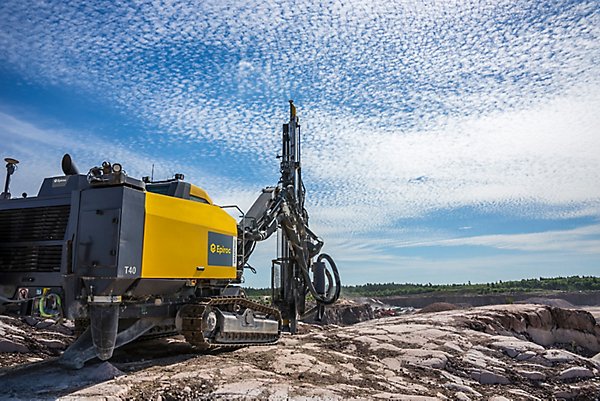
Mining & Quarry Drill Rigs


Republic Drill Co. supplies surface mining and quarry drill rigs for production blasthole drilling, bench development, pre-split and trim rows, aggregate and dimensional stone quarrying, and construction rock excavation. These are pattern-drilling programs where the cost per drilled meter, not the day rate, decides whether the pit is profitable.
As an Epiroc dealer we supply SmartROC and FlexiROC surface rigs — top hammer units such as the T30 R, T40 and T45 for smaller-diameter production and construction work, DTH units such as the D60 and D65 for larger holes and deeper benches, and rotary blasthole rigs including the DM45 and DM50. We also supply all of the rock drill tooling you might need. Rigs are quoted with the automation, dust control and cabin options that match the site, and used iron is available when a schedule won't wait on a build slot.
Production drilling consumes tooling, so the support side is the relationship: rods, shanks, couplings, bits and DTH hammers stocked by size and rock type, rock drill oil and wear parts on the shelf, and technicians for commissioning, rock drill rebuilds and hydraulic work. The outcome for the operator is a predictable pattern — holes drilled straight and to depth, fragmentation the shovel and crusher can handle, and drills that stay on the bench through the quarter.
Featured rigs & equipment


Mining drilling methods and the equipment they take
Top hammer
Percussion at the top of the rod string, transmitted down the steel. Fastest and lowest cost per meter in the 2.5"–5" range for benches under roughly 25 m.
SmartROC / FlexiROC T-series, rods, shanks, couplings, button bits
Down-the-hole (DTH)
Hammer at the bit face. Straighter holes, less energy loss with depth, and the method of choice for larger diameters and deep benches or pre-split rows.
SmartROC / FlexiROC D-series, 4"–8" hammers and bits
Rotary blasthole
Weight-on-bit and rotation with tricone bits for large-diameter production holes in softer to medium rock at high pulldown.
DM45 / DM50, tricone bits, drill pipe, deck bushings
Pre-split & trim drilling
Closely spaced, precisely aligned holes drilled to protect the final wall. Hole straightness and angle accuracy matter more than raw speed.
Angle indication, hole navigation, small-diameter bits
Secondary breakage & construction
Boulder busting, trenching, foundation and roadway rock work handled with smaller construction-class rigs.
Construction Edition rigs, hydraulic breakers, short rods
How to choose the right mining rig
- 01
Start with the drill pattern
Hole diameter, bench height and burden/spacing come from the blast design. Those three numbers determine method and rig class before any brand discussion.
- 02
Top hammer vs DTH is a depth and diameter call
Top hammer wins on cost per meter in shallower benches and smaller holes. DTH wins on hole straightness and energy delivery as depth and diameter increase.
- 03
Size the compressor to the hole
For DTH, cfm and psi at depth set penetration rate and hole cleaning. For top hammer, flushing air still governs how clean the hole stays.
- 04
Match the carrier to the bench
Tramming distance, bench grade, ground conditions and how often the rig relocates decide undercarriage and drive spec.
- 05
Decide how much automation you'll use
Hole navigation, auto-rod handling and drill plan integration pay off on repeatable patterns and large fleets — less so on a single rig doing varied work.
- 06
Budget tooling as a line item
Consumable cost per meter is often larger than rig ownership cost. Rock type, bit selection and rod maintenance move that number more than anything on the spec sheet.
Specifications buyers compare — and why they matter
| Specification | Why it matters |
|---|---|
| Hole diameter range | The core spec. Rig class, tooling and blast design all key off it. |
| Rock drill / hammer power output (kW) | Percussive power available at the bit, and the main driver of penetration rate in hard rock. |
| Maximum hole depth | Rod capacity and feed length determine whether the bench can be drilled in one pass. |
| Compressor output (cfm at psi) | Sets DTH performance and hole cleaning; undersized air costs both speed and bit life. |
| Feed force and feed length | Feed length sets rod changes per hole; feed force affects straightness and steel life. |
| Rod handling / carousel capacity | Rods carried on board determines how deep you can go without manual handling. |
| Tramming speed and gradeability | How much of the shift is spent moving between holes and benches. |
| Dust collection and suppression | Silica compliance and visibility on the bench — a regulatory item, not an option. |
| Angle drilling capability | Required for pre-split, trim rows and wall control work. |
| Engine tier and fuel consumption | Emissions compliance plus a direct, measurable line in cost per meter. |
Who we represent in mining drilling
The support behind the rig
Drill pipe & rod
Perforator DTH, rotary and RC drill pipe, subs and crossovers matched to your rotary head thread, torque rating and hole depth.
Drill pipe →Bits, hammers & tooling
DTH hammers and bits, tricone and drag bits, rock drill steel, shanks, and couplings stocked by size and formation.
Tooling →Parts & consumables
Wear parts, filtration, hydraulics, rock drill oil, and thread compound. Stocked items ordered by 3PM CST ship next day.
Consumables →Field service & shop repair
Rig commissioning, preventive maintenance, hydraulic and rotary head rebuilds, and troubleshooting — in the shop or on location by territory.
Field service →Aggregate quarry, bench production drilling
A quarry running top hammer on a deepening bench saw hole deviation rise and rod consumption climb as the face got taller. The pattern was designed for a shallower bench and the tooling program hadn't changed with it.
Moving the deeper rows to DTH while keeping top hammer on the shallow benches, and standardizing rod and bit sizes across the fleet, restored hole accuracy on the toe and simplified the consumable order.
Mining equipment questions we get asked
Top hammer or DTH for quarry blasthole drilling?
Top hammer is generally the lower cost per meter in holes up to roughly 5" on benches under about 25 m. DTH delivers straighter holes and holds penetration rate better as diameter and depth increase. Many pits run both across different benches.
Which Epiroc surface rigs does Republic supply?
SmartROC and FlexiROC top hammer and DTH rigs — including the T30 R Construction Edition, T40, T45, D60 and D65 — plus rotary blasthole rigs such as the DM45 and DM50. See the featured rigs above for current catalog records.
How do I reduce cost per drilled meter?
Match method to bench geometry, size air correctly, keep tooling matched to the rock, and track bit and rod life by pattern. Consumable cost and hole accuracy usually move the number more than rig selection alone.
Do you stock rock drill tooling and consumables?
Yes — rods, shanks, couplings, button bits, DTH hammers and bits, plus rock drill oil and wear parts. Stocked items ordered by 3PM CST ship next day.
Do you service mining drills in the field?
Yes. Commissioning, preventive maintenance, rock drill and hydraulic rebuilds, and troubleshooting, assigned by service territory.
Can you help with dust control compliance?
Dust collection and suppression options are quoted with the rig. Tell us the site's requirements and we'll spec accordingly.
Get a quote on mining drilling equipment
Send us the program — formation, depth, hole diameter and access — and we'll quote the rig, tooling and support package that fits it.
Everything else we run.
One Republic, four ways we keep you drilling.
Services
Field service, shop rebuilds, audits, site planning, and driller training — the wraparound that keeps programs running.
Parts
OEM and aftermarket parts pulled from trucks, not catalogs. NEXT-DAY SHIP OF STOCKED ITEMS from four locations.
Tooling
Bits, hammers, fluids, and the kit that gets pulled before the truck leaves the yard.